Showing posts with label Arnold. Show all posts

Sunday, June 9, 2019

Subarctic Great Horned Owl

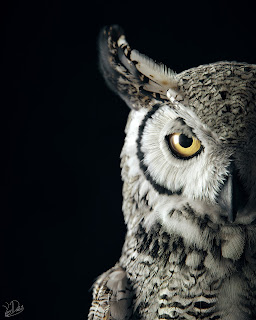
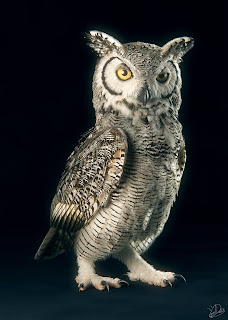
In this project, I tried to create a photorealistic and anatomically accurate model of Subarctic Great Horned Owl. All grooming and scattering works of feathers I used Yeti, the owl has real fiber feathers (total count feathers - 6327 and 2188922 fibers) and I didn't use any poly plane feathers. As always, for shading, I used melanin centric Arnold Hair shader with a complex network.
Example shading of the body and the wing:


Average render time: 8k ~32h, 4k (head images) ~14h. Also, I want to say many thanks to my friend Maxim Shamarin for helping in rendering on his workstation.
I chose 5 color correction style and below you can see these images





And some fun stuff- mesh without feathers:


Thursday, March 21, 2019

My ArnoldGPU (betta) test with Yeti

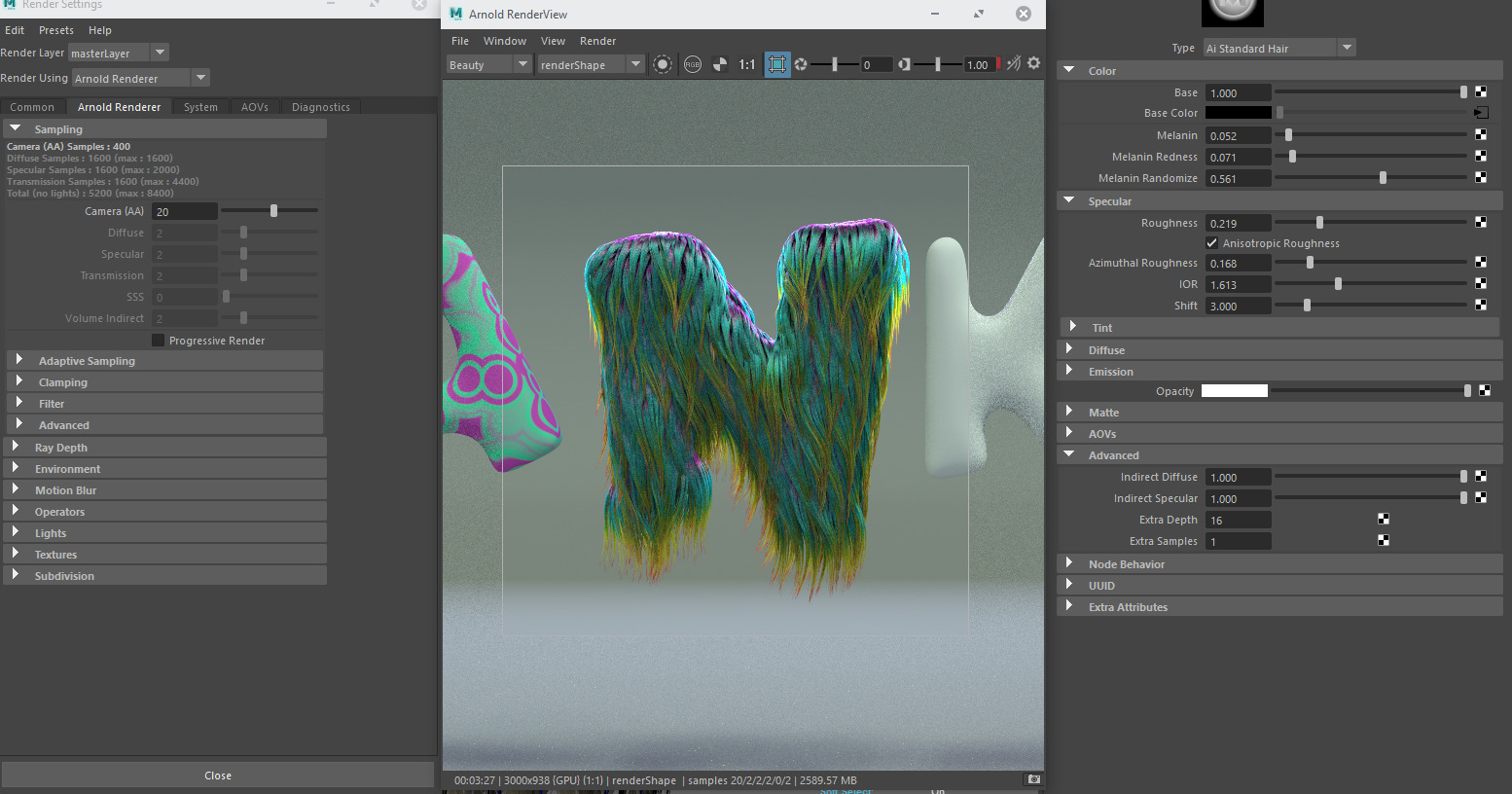
As a groomer, I always interest how works new render features with hair and fur, so I did the test on my Ringil workstation new version of MtoA 3.2.0, Maya 2018.5 and Yeti 3.1.7
2xXeon 2683v3 (28core all turbo 2.78Ghz) vs AORUS GTX 1080 Ti Xtreme Edition 11G, Nvidia drivers 419.35 and 419.67.


The render time with approximately the same level of grain (CPU/GPU): 4m38sec/3m34s
I understand that Arnold GPU is the betta and PeregrinLabs not yet release Yeti for new Arnold core, but: no support Maya light links, Hair shader need tweaks to "CPU" look (incorrectly solution tweaking by increasing Indirect Spec)

  "CPU" looks  (419.35 driver) 4m38sec

"GPU" original version (419.67 driver) 3m27sec

"GPU" corrected version  (419.35 driver) 3m34sec

After updating NVidia driver to 419.67 the render time little decrease: 3m28sec (3% faster) and after overclocked GPU on 25Mhz (from 1999.5 Mhz up to 2025) render time: 3m25sec (4.3% faster than on very first result)
Also if you have small black dots (I had this issue on 419.35 version of display driver) just reopen ArnoldRenderView

Although as for betta looks hopeful. Keep rocking Arnold Autodesk team


Friday, September 14, 2018

Cheetah Family

My latest work is devoted to these wonderful animals, which soon may be lost.
I tried to achieve photorealistic similarity to real animals in their habitat, and I hope you will like the result.


All grooming work and grass scattering I did in Yeti 2.2.8.
Yeti tree of adult cheetah

Shading and rendering in Arnold (core 5.x.x) in which I used aiStandartHair and melanin centric texturing:
Fur shader of adult cheetah

crypto_object pass

viewport

Fusion CC tree


More info coming soon...

Statistic:
Total fur density ~19.5M fibers
Total blades of grass - 108453
Ram used during render ~39Gb
Render time- 9h51m on Ringil workstation
Also, you can buy the model of the adult cheetah here   or 

Friday, December 1, 2017

The Baby Cheetah in studio

 few variation CC


HI-res:  


render.ru and posted in Render Magazine 01/2018


CG Society Award


Statistic:
Fur density - 3736698 fibers
Body fur consist of 7 layers and have only 3 fur system
Render time on Ringil workstation res 3032x4096px- 3h56m
Usage memory when rendering 4k res ~ 9Gb
Body mesh: 3udims, 39362poly
Groom textures: 2 additive RGB textures (2k and 8k), 3 luma texture (2*8k, 1*1k)
SSS textures: 5*8k
Fur textures: 4*8k
Soft: Maya 2017, mtoa 2.1.0.1, Yeti 2.2.4


Thursday, September 14, 2017

Yeti and Arnold or V-Ray motion blur bug fix

If you need to get a working motion blur using V-Ray or Arnold and you have had such problems:

V-ray (normal/with bug)

you need to make a few changes.
If you use in your Yeti tree any expressions with Position attribute (P) then you need:
For Yeti 2.1.xx
1. for all objects from which you get P attribute you need create texture reference objects;
2. replace all P on Pref
For Yeti 2.2
1. the same step as for Yeti 2.1.xx
2. P -> Pundef

If you have this bug and you use VRay, then render time increase approximately x3.3

Wednesday, February 24, 2016

ZOIC – ARNOLD CAMERA SHADER

Nice camera shader for the Arnold renderercapable of simulating some optically imperfect lens effects.


Download, documentation and more info  >>> here <<<